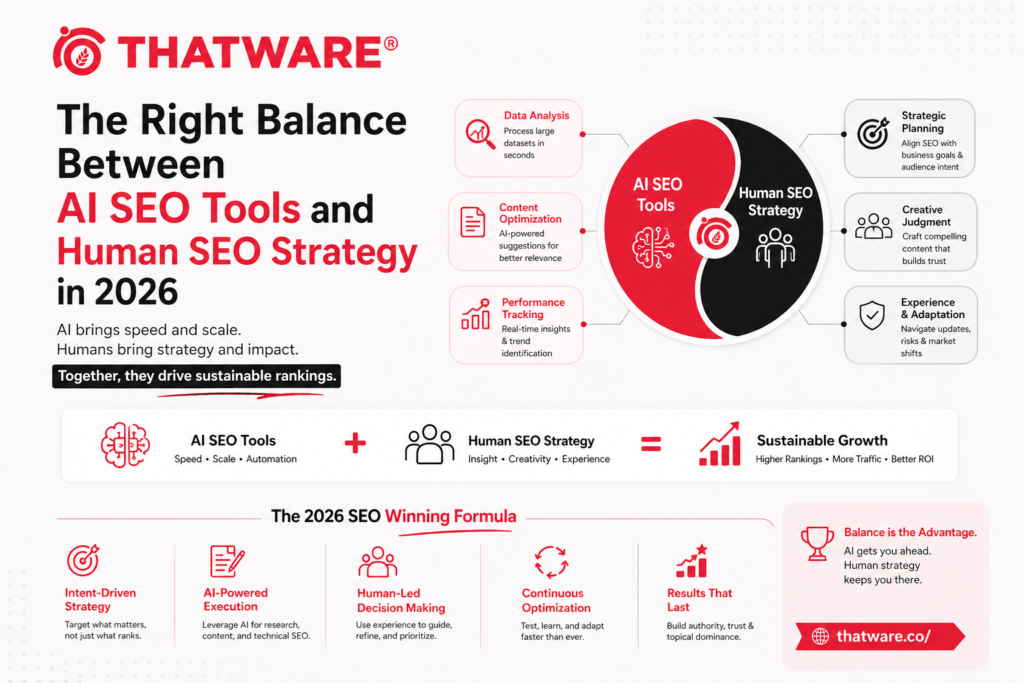
There’s a version of this conversation that happens inside every marketing team that’s been paying attention to AI tool development. Someone brings up the latest AI SEO platform that promises to automate keyword research, generate content at scale, build link profiles, and produce reporting dashboards. Someone else raises concerns about quality, about over-reliance on automation, about what happens to the work when the tool changes its pricing. Everyone agrees the tools are impressive and disagrees about how much to trust them.
The conversation is genuinely worth having, and it deserves more nuance than either the enthusiastic automation advocates or the skeptical traditionalists typically provide.
The real question isn’t whether to use AI tools. It’s which decisions AI tools should inform versus which decisions require human judgment, and what happens when the wrong decisions get delegated to the wrong type of intelligence.
Where AI Tools Are Clearly Valuable
The tasks where AI tools produce clear, measurable value in SEO share a few characteristics. They’re high-volume, they’re rule-based or pattern-recognition-based, and they’re tasks where speed and coverage matter more than contextual nuance.
Technical auditing at scale is the clearest example. Running crawl analysis across thousands of pages, identifying broken links, flagging duplicate content, checking structured data implementation, monitoring Core Web Vitals across a large site. These are tasks where AI tools dramatically increase the coverage and frequency possible without proportionally increasing the human time required. A technical SEO team that runs monthly crawls manually can run weekly or daily monitoring with proper tooling.
Keyword research and opportunity identification is another strong area. AI-assisted keyword research tools can process vastly more data than human analysis alone, identifying semantic clusters, search trend patterns, and competitive gaps at a scale that manual research can’t match. The output of AI-assisted keyword research isn’t a final strategy. It’s a more comprehensive input set for human strategic decisions.
Content performance analysis across large content libraries uses AI well. Identifying which content clusters are growing or declining in performance, which pages have behavioral signals suggesting quality problems, which topics are driving commercial conversions versus pure traffic, these analyses process more data more quickly with AI assistance than without.
Ai seo services that deploy AI tooling in these high-volume analytical roles produce genuine efficiency gains that translate into better strategic decisions.
Where Human Judgment Remains Essential
The tasks where delegating too much to AI tools consistently produces disappointing results share different characteristics. They require contextual understanding of the business, they require creative judgment that goes beyond pattern matching, or they require the kind of authentic expertise that language models can approximate but not replicate.
Strategic prioritization is where human judgment is most critical. The decision about which keyword clusters to target given the brand’s specific competitive situation, business model, and resource constraints requires understanding the business context that no tool has. AI can produce excellent data inputs for this decision. The decision itself needs human judgment.
Brand voice and content authenticity are areas where AI assistance has real limits. Content that demonstrates genuine expertise, that reflects authentic experience with a topic, that carries the voice and perspective of a knowledgeable practitioner, reads differently from content that’s generated to match patterns of what expert content looks like. The difference is increasingly detectable both by sophisticated readers and by search quality evaluation systems.
Relationship-based work, specifically the editorial relationships, source cultivation, and genuine community participation that drives the most valuable link building and PR outcomes, requires human relationship-building that AI tools can support but can’t replace.
Ai driven seo services that understand this distinction use AI to make human judgment more informed and efficient rather than treating AI as a substitute for it.
The Failure Mode of Over-Automation
The organizations that have had the worst experiences with AI SEO tools tend to have made the same category of mistake: delegating decisions that required human judgment to automated systems and not maintaining sufficient oversight to catch when the automation was producing poor outputs.
AI-generated content published at scale without meaningful human review is the most visible failure. The content is technically coherent, often passes surface-level quality checks, and fails the deeper quality evaluation that determines whether it actually serves searchers and earns durable rankings. Sites that went all-in on AI content generation without editorial oversight have often found that the apparent efficiency gain was offset by ranking declines that cost more to recover from than the content production cost savings.
Automated link building is another failure mode. Tools that generate link requests at scale, or that build link profiles through automated means, produce patterns that search algorithms are increasingly good at identifying and discounting. The efficiency of automation in this area is largely illusory because the output doesn’t produce genuine value.
Building the Right Human-AI Workflow
The working model that produces the best outcomes in 2026 treats AI tools as infrastructure that amplifies human capability rather than infrastructure that replaces it.
Data collection and processing: AI tools. Analysis and pattern identification: AI tools with human interpretation. Strategic decisions and prioritization: human judgment informed by AI analysis. Content creation: human expertise with AI assistance for research and drafting. Content review and brand calibration: human. Technical implementation: AI-assisted with human oversight. Performance monitoring: AI tools with human interpretation of what the signals mean.
This workflow produces programs that are faster, more comprehensive, and more analytically informed than purely manual approaches, while maintaining the human judgment that determines whether the work is actually serving the right objectives.
The balance isn’t static. As AI tool capability improves, some decisions that currently require human judgment will be better served by AI assistance. But the principle, that human strategic judgment and authentic expertise are the inputs that AI tools should be amplifying rather than replacing, is likely to remain relevant regardless of how capable the tools become.
